



Performance management plays a key role in how organisations track progress and achieve business goals. FAST goals offer a modern approach to performance management by focusing on goals that are Frequently discussed, Ambitious, Specific, and Transparent.
Key Takeaways:
- FAST goals improve performance management by encouraging regular communication, transparency, and continuous feedback between employees and managers in modern workplaces.
- It differs from traditional goal-setting methods by remaining flexible and adaptable, helping organisations respond effectively to changing priorities and business environments.
- The FAST framework supports stronger accountability, collaboration, and employee engagement by creating clear objectives that align individual performance with organisational goals.
FAST goals encourage regular conversations between managers and employees, making performance tracking more dynamic and collaborative. This approach helps ensure that goals remain relevant and aligned with organisational priorities. Many organisations adopt FAST goals to improve flexibility and employee responsiveness as workplaces become more agile and business priorities change more frequently.
By shifting the focus from static targets to ongoing discussions and clear expectations, FAST goals improve clarity, accountability, and engagement within teams. They help organisations create a performance culture where progress is continuously reviewed and adjusted, leading to better results and stronger alignment between individual and business objectives.
What Are FAST Goals?
FAST goals are a modern goal-setting framework. It is used to improve workplace performance management through continuous communication, clarity, and transparency. The FAST framework was developed to help organisations move beyond traditional annual performance reviews and create a more flexible approach to managing employee performance and business objectives.
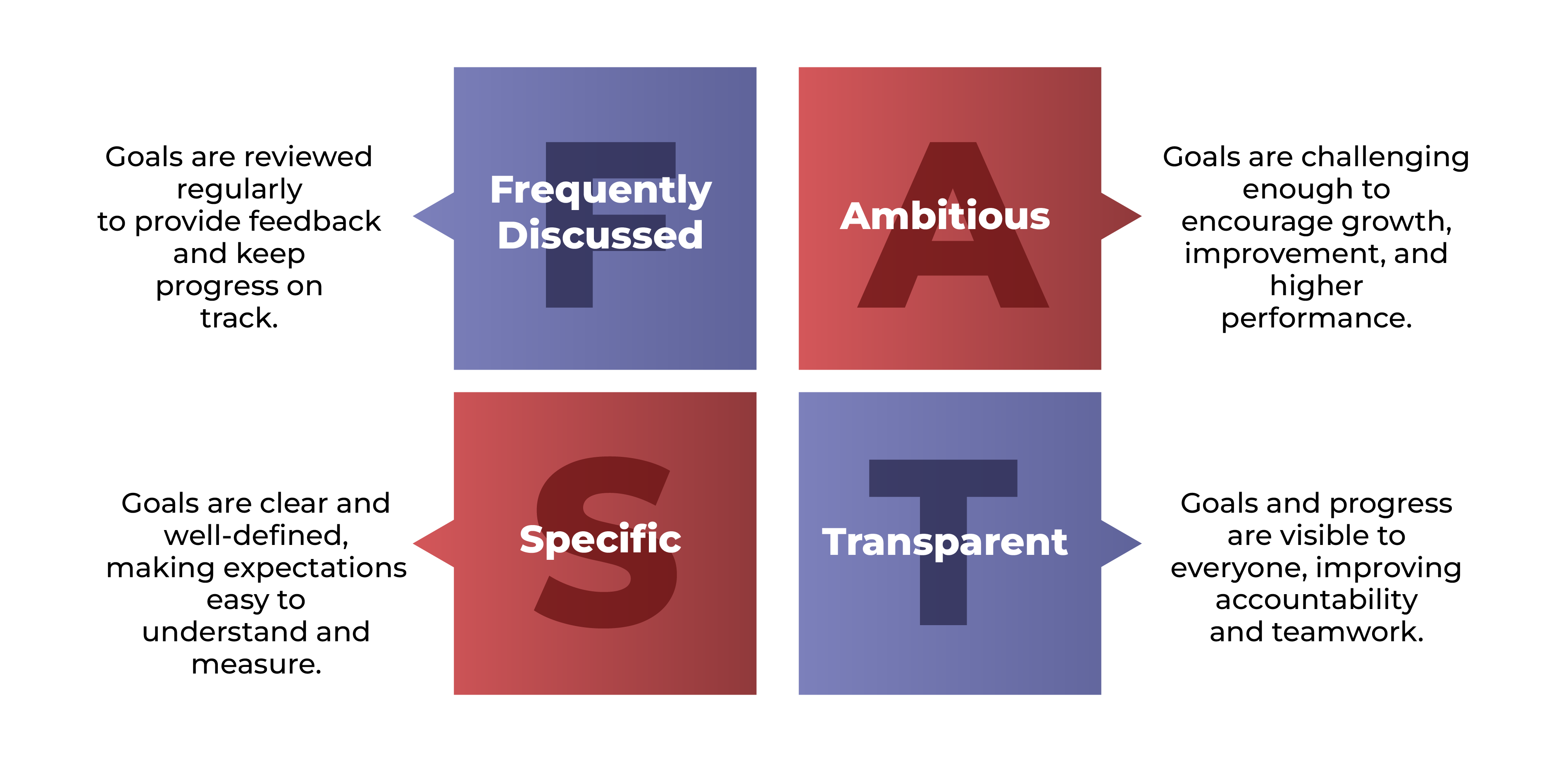
The term FAST stands for Frequently Discussed, Ambitious, Specific, and Transparent.
- Frequently Discussed: FAST goals are designed to be discussed regularly between employees and managers rather than reviewed only once or twice a year. This helps track progress, address challenges early, and keep goals aligned with changing priorities.
- Ambitious: FAST goals encourage employees and teams to aim higher by setting challenging but achievable targets. Ambitious goals promote motivation and professional growth by pushing individuals beyond routine performance levels.
- Specific: Goals within the FAST framework must be clear and well-defined so employees understand exactly what is expected of them. Specific goals make it easier to measure progress and performance.
- Transparent: Transparency means that goals, progress, and performance are visible across teams and departments. This openness improves accountability and helps employees understand how their work contributes to wider business objectives.
The main purpose of FAST goals in workplace performance management is to create better alignment between employees and organisational objectives.
Why Traditional Goal-Setting Methods Often Fail?
There is a great difference between traditional goal setting and FAST goal setting.
- Traditional goal-setting methods often rely on annual or quarterly reviews, which limit regular communication and delay feedback that employees need for improvement.
- Many traditional goals are too rigid and fail to adapt to the changes of business priorities and market conditions.
- Employees may lose motivation when goals are discussed only occasionally, making performance management feel disconnected from daily work.
- Lack of transparency in traditional systems can create confusion about expectations, priorities, and individual contributions within teams.
- Some organisations focus heavily on measuring results while following the traditional goal setting, and give very little attention to employee development.
- Traditional performance management methods can encourage employees to focus only on meeting fixed targets rather than improving creativity, innovation, and problem-solving abilities.
- Goals are sometimes written in vague or overly broad terms, making it difficult for employees to clearly understand what success actually looks like.
- In fast-changing industries, static goal-setting approaches struggle to keep pace with digital transformation, evolving customer demands, and agile ways of working.

How FAST Goals Improve Performance Management?
FAST goals improve project performance management by creating a more flexible and transparent approach to setting objectives. They help organisations maintain continuous feedback, improve collaboration, and keep employees aligned with changing business priorities. This framework also supports stronger accountability and more consistent performance improvement across teams.
Encourage Continuous Communication
FAST goals improve performance management by encouraging regular communication between managers and employees. Instead of waiting for annual reviews, teams discuss progress, challenges, and expectations more frequently. This ongoing interaction helps employees stay aligned with organisational goals and allows managers to provide faster feedback and support when needed.
Clear Objectives
The FAST framework focuses on setting goals that are clear, measurable, and easy to understand. Specific objectives reduce confusion around expectations and help employees understand exactly what they need to achieve. This clarity improves focus and overall performance by keeping attention on measurable outcomes.
Transparency Across Teams
FAST goals promote transparency by making goals and progress visible across teams and departments. Shared visibility improves accountability because employees can clearly see how their work contributes to wider business objectives. It also strengthens collaboration, as teams are better able to coordinate efforts and support each other effectively.
Ambitious Targets
Ambitious goals encourage employees to push beyond routine performance and develop new ideas and skills. FAST goals help create a growth-focused environment where employees feel motivated to improve and contribute more actively. At the same time, these targets are balanced with realistic expectations to ensure goals remain achievable and productive rather than overwhelming.
Adaptable
FAST goals are designed to remain flexible in changing work environments. Organisations can quickly adjust goals in response to new priorities, market conditions, or operational changes without disrupting overall performance management. This adaptability helps businesses respond more effectively to challenges and opportunities.
Team Collaboration
Transparency within the FAST framework improves teamwork and communication across departments. It becomes easier to coordinate tasks, support colleagues, and work towards common objectives when employees see shared goals. This creates a more connected and collaborative workplace culture.
Practical Examples of FAST Goals
The following are the practical examples of FAST goal-making. It tells how they can be incorporated into daily life.
For Marketing Team
A marketing team may set a FAST goal to increase social media engagement. They set a goal to increase it by 25% within three months through regular content campaigns and audience engagement.
Progress is reviewed weekly, allowing the team to adjust strategies based on campaign performance and customer response.
This keeps goals visible, measurable, and aligned with overall business growth objectives.
For the HR Department
An HR department might create a FAST goal focused on improving employee retention by introducing monthly training sessions and career development plans.
Managers and HR teams regularly review employee feedback, participation rates, and retention data to measure progress.
This approach helps maintain continuous improvement while supporting employee satisfaction and organisational development.
Ready to Lead Projects Like a Professional?
Start OTHM Level 7 Diploma today and move one step closer.
Enrol Now!Conclusion
FAST goals provide a more modern and flexible approach to performance management by encouraging continuous communication, transparency, and measurable progress. Unlike traditional goal-setting methods, they help organisations adapt quickly to changing priorities while keeping employees engaged and aligned with business objectives. Adopting the FAST goal framework helps businesses improve productivity and the effectiveness of overall performance management.